.svg)







IAA TRANSPORTATION Weekly | 24/2026
IAA Media Summit, Mercedes-Benz Trucks, Kia, SMATRICS, i-charging
Exhibitors offer a preview of topics and innovations for IAA TRANSPORTATION 2026 at the IAA Media Summit, Mercedes-Benz Trucks expands its e-truck portfolio with a new eActros Lowliner variant, Kia presents its entire PV5 family and PBV strategy at IAA TRANSPORTATION, SMATRICS launches an e-logistics network for shared depot charging infrastructure, and i-charging introduces a 500-kW charging system for passenger cars and commercial vehicles—these are the top news stories for week 24 of 2026.
Exhibitors offer a preview of topics and innovations for IAA TRANSPORTATION 2026 at the IAA Media Summit, Mercedes-Benz Trucks expands its e-truck portfolio with a new eActros Lowliner variant, Kia presents its entire PV5 family and PBV strategy at IAA TRANSPORTATION, SMATRICS launches an e-logistics network for shared depot charging infrastructure, and i-charging introduces a 500-kW charging system for passenger cars and commercial vehicles—these are the top news stories for week 24 of 2026.
- 1. IAA Media Summit 2026: Exhibitors Provide a Preview of Topics and Innovations for IAA TRANSPORTATION 2026
- 2. Mercedes-Benz Trucks expands e-truck portfolio with new eActros Lowliner variant
- 3. Kia Presents the Complete PV5 Family and Its PBV Strategy at IAA TRANSPORTATION
- 4. SMATRICS launches e-logistics network for shared depot charging infrastructure
- 5. i-charging presents 500 kW charging system for passenger cars and commercial
Anticipation for IAA TRANSPORTATION 2026 is building: Around three months before the launch of the world's leading platform for transport, logistics, and commercial vehicles, international media representatives and leading industry figures gathered at the IAA Media Summit in Frankfurt. Through keynotes, panel discussions, and an interactive networking tour, leading companies from the commercial vehicle industry provided exclusive insights into their latest developments. They also shared a preview of the most important innovations and topics at this year's event—ranging from alternative drivetrains, connected and autonomous vehicles, and software-defined vehicles to AI-powered logistics solutions and the expansion of charging and hydrogen infrastructure. One thing became clear: The technology for transforming the transport sector is ready, but faster progress is needed regarding infrastructure and political frameworks.

Mercedes-Benz Trucks is expanding its electric long-haul series with the new Mercedes-Benz eActros Lowliner, which was specially developed for high-volume transport with mega-trailers. The model is expected to be available for order starting in the third quarter of 2026, with series production at the Wörth plant kicking off in 2027.
Technically based on the eActros 600, the Lowliner is offered as a 4x2 tractor unit. Customers can choose between two LFP battery variants: the eActros 400 Lowliner with 414 kWh and a higher payload of up to 24 tons, and the eActros 600 Lowliner with 621 kWh and a range of up to 500 kilometers (approx. 311 miles).
Standard charging is handled via CCS2 at up to 400 kW, with the Megawatt Charging System (MCS) available as an option. Depending on the battery size, charging from 10 to 80 percent takes around 46 to 70 minutes.
The Lowliner is driven by an electric axle featuring two electric motors, a four-speed transmission, 400 kW of continuous output, and 600 kW of peak power. Regeneration and the predictive drivetrain control system, Predictive Powertrain Control, are designed to further optimize efficiency and range in long-haul transport.
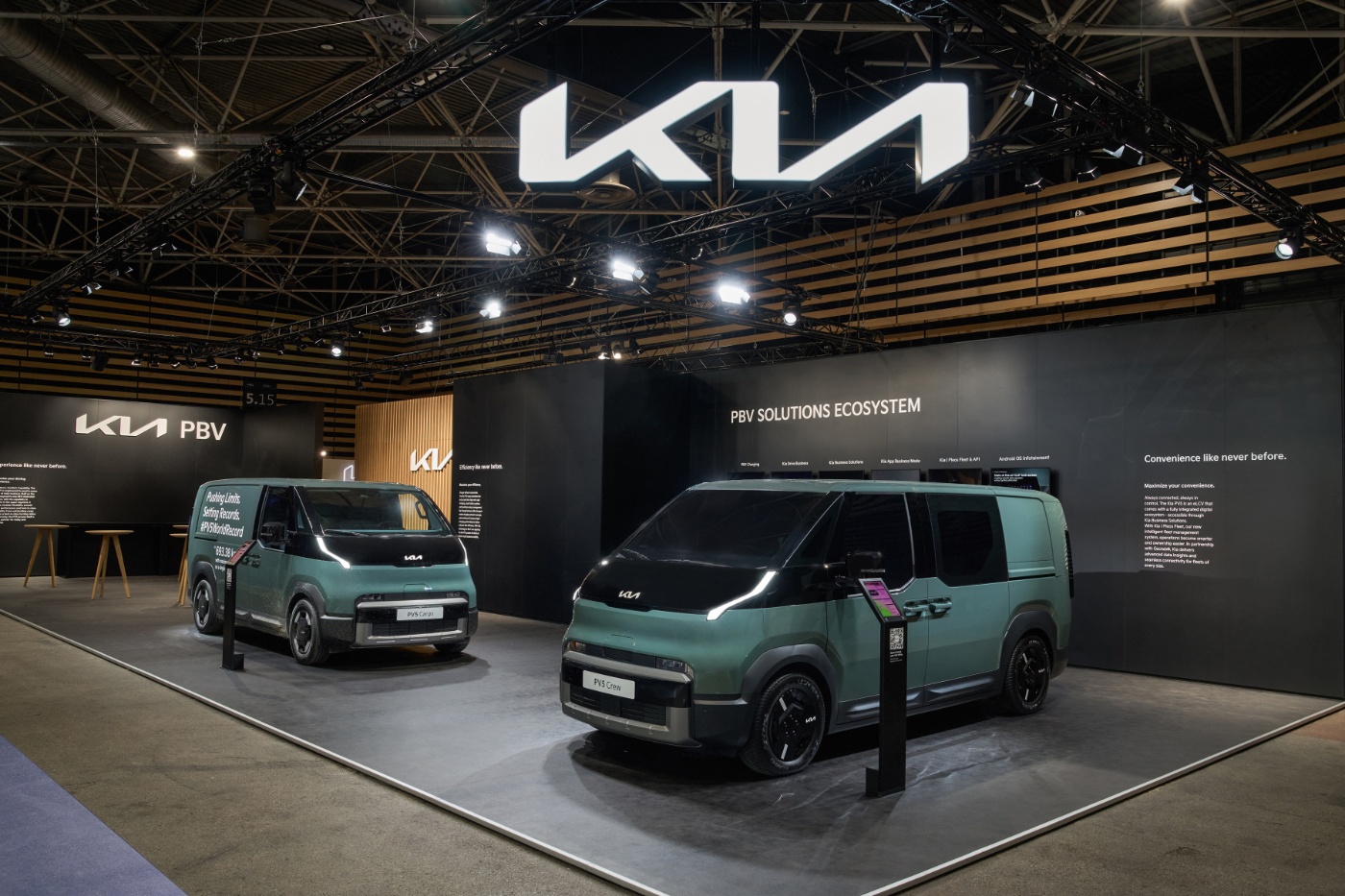
Kia will showcase its complete all-electric PV5 family and introduce the next phase of its "Platform Beyond Vehicle" (PBV) strategy at IAA TRANSPORTATION 2026. On display will be various body variants designed for different commercial applications, including the PV5 Cargo L2H2 and L1H1 vans, the PV5 Chassis Cab, the seven-seater PV5 Passenger, the wheelchair-accessible PV5 WAV, and a PV5 food truck. The PV5 models are based on the E-GMP.S electric platform, which was specifically developed for commercial vehicles, and are designed to offer high practicality, efficiency, and flexibility. Key features include a tight turning radius, low loading and step-in heights, and a modular body architecture intended to simplify repairs, lower costs, and reduce downtime. With the PBV concept, Kia is taking a holistic approach to electric mobility solutions for commercial use.

The Austrian charging infrastructure provider SMATRICS has launched the "Depot Club," a network for the shared use of depot charging infrastructure for e-trucks. The goal is to connect depot operators and logistics companies, increase the utilization of existing charging stations, and provide additional charging options along major transport corridors.
At launch, Hasenöhrl Bau GmbH and Friedl GmbH are participating by opening up their charging infrastructure to network members at several locations in Austria. Plans to expand to additional locations in Austria and Germany are already underway.
The concept allows depot operators to make open charging windows available to other companies, thereby generating additional revenue. At the same time, e-truck fleets gain access to predictable charging stations along their routes without having to invest in new infrastructure themselves. This is intended to prevent detours, redundant investments, and isolated "charging silos."
With the Depot Club, SMATRICS aims to create a connected charging ecosystem tailored to actual transport flows, improving the economic efficiency of electric logistics. In the long term, the network is designed to increase the availability of e-truck charging infrastructure, accelerate the market ramp-up of battery-electric commercial vehicles, and make it easier for smaller logistics companies to transition to electromobility via charging-as-a-service models.

i-charging has announced the all-in-one 500 (AiO 500), a standalone EV charger that delivers 500 kW from a single compact unit. The solution was designed for highway corridors, fuel station replacements, and high-density urban locations where both maximum power and minimal footprint are critical, with support for CCS, NACS and GB/T for deployment across multiple markets.
The AiO 500 has two outputs and distributes power dynamically between them, based on what each connected vehicle is drawing at any given moment. No operator input is required. The total 500 kW capacity remains available regardless of how demand is split between the two connectors.
The 500 kW ceiling is relevant as a growing number of production electric vehicles now support charging rates at or above 400 kW. Where a site has an all-in-one unit capped at that level, a single vehicle charging at full rate occupies the full installed capacity. AiO 500 is sized to serve both outputs at high power simultaneously.
All-in-one 500 incorporates i-charging’s patented dynamic power allocation technology, distributing available power between both outputs in real time based on vehicle demand.
When two vehicles are connected, power is allocated based on what each can receive at that moment. If one vehicle requires higher power than the other, the system adjusts accordingly. This improves utilisation of installed capacity and supports shorter charging sessions.
The 500 kW total output is aligned with the increasing charging capabilities of next-generation electric vehicles, allowing high-power charging on one output while maintaining full availability on the second.
The standard cable configuration supports sustained delivery up to 500 A. An optional liquid-cooled cable version is available for applications requiring higher sustained current. Commercial and heavy-duty vehicles require higher sustained current over longer periods than standard cables can reliably deliver. With liquid-cooled cables, the AiO 500 is suited to freight, coach and heavy transport operations alongside passenger vehicle charging, from a single compact unit.
The AiO 500 comes with the same 32" touchscreen, contactless card reader, and optional bank card terminal as the rest of our standalone solutions. Plug&Charge and Autocharge are supported. It runs OCPP 1.6 and 2.0.1 and connects via 4G modem or Ethernet. Operators managing existing i-charging chargers through my.i-charging will find the all-in-one 500 on the same platform.
First deliveries of the AiO 500 are scheduled to begin at the end of 2026 for CE markets and 2027Q1 for North America and Eichrecht markets. i-charging is currently working with early adopters to finalise deployment specifications and secure installation slots.