.svg)
What does the IAA TRANSPORTATION slogan "We Deliver" mean to you?
For us, "We Deliver" means that our standards have to prove themselves in our customers' day-to-day operations. A commercial vehicle must fulfill its transport task reliably and economically. That is why we do not just think about the drive system, but also about payload, energy efficiency, safety, spare parts, and service. We want to help fleets reduce emissions without compromising their operational performance. What counts are tangible, clear results in each specific application—not broad promises.
What do you hope to achieve at IAA TRANSPORTATION 2026, and what are you most looking forward to?
Our first time participating in IAA TRANSPORTATION is an important step in our long-term European growth. We want to raise awareness of Farizon and, above all, engage in in-depth conversations with fleet operators and partners. What we are looking forward to most is direct dialogue about what vehicles need to deliver in daily operation: which routes they are used on, what loads they transport, and what charging and service conditions are required. For us, success means taking home concrete technical and economic feedback and building relationships that last well beyond the trade fair.
Which topic will you be presenting at IAA TRANSPORTATION 2026?
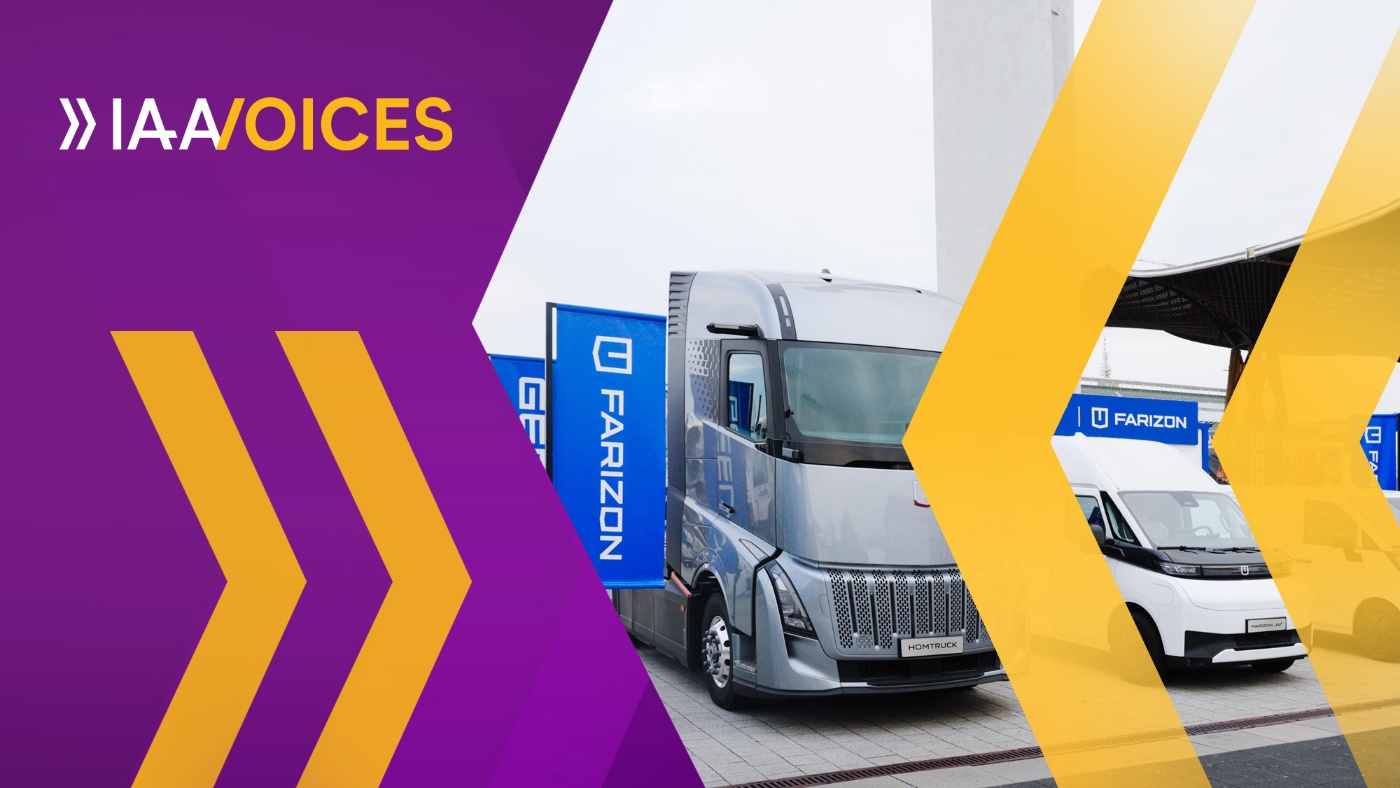
We are showcasing three complementary product perspectives. The fully electric Homtruck is celebrating its European debut and represents demanding tasks in heavy duty transport and long-haul operations. With the Farizon SV, we are offering a preview of the upcoming model year, featuring planned advances in battery, motor, and all-wheel drive capabilities. The V7E is targeted at urban delivery services and last-mile operations, where usable cargo space, easy loading, and efficiency matter most. Together, these vehicles demonstrate why different transport tasks require different solutions. The Homtruck debut is not yet a confirmed European market launch; the SV is a preview. Final specifications and availability will be announced separately.
In which area of the transport and logistics sector do you see the greatest potential, and where is the greatest need to catch up?
We see the greatest potential in systematically aligning the electrification of heavily used commercial vehicles with their actual transport tasks. This ranges from urban delivery to heavy freight transport. Rather than relying on a single key metric, what matters is the interplay of route, payload, energy requirements, and operating costs. We see the greatest need for action in implementing this approach consistently across the board: vehicle technology, charging conditions, financing, and local support must all fit together. A transition only becomes viable for a business when spare parts supply, service, and cost-effectiveness in actual operation are fully factored in.
IAA TRANSPORTATION is the leading global platform for commercial vehicles, transport, and logistics. It brings together innovators from all spectrums of mobility. Who are you looking to connect with this coming September, and why?
We are primarily looking to exchange ideas with fleet operators, logistics companies, and potential distribution and service partners. When it comes to heavy commercial vehicles, we particularly value the experiences of operators running demanding regional and long-haul routes. Their insights into routes, capacity utilization, and infrastructure help us tailor vehicles and support to real-world requirements. Together with local market partners, we want to further develop the prerequisites for reliable sales, parts supply, and service. Dialogue with policymakers and the media is also important. Our goal is to build long-term relationships that foster technical understanding and trust—not just contacts for the duration of the trade fair.
The transformation in the transport and logistics sector toward sustainable solutions is significant. What is your vision for the transport and logistics industry in 10 years?
My vision is a transport industry in which lower-emission vehicles are a naturally integrated part of a commercially viable operation. Fleets should be able to select the right vehicles for various routes and loads and rely on stable charging conditions, spare parts supply, and service. Sustainability encompasses the entire lifecycle: manufacturing, transport, energy supply, usage, and end-of-life. Farizon wants to contribute to this with efficient, durable commercial vehicles and a lasting local presence. For me, the crucial factor is thinking about lower emissions, high vehicle availability, and operational productivity together.
How is AI transforming your company?
Our benchmark for smart technology is its practical value: it should improve energy efficiency, safety, and vehicle availability. Among other initiatives, Farizon is working on intelligent energy management and driver assistance systems. Specific features depend on the model, configuration, and market. Driver assistance here should not be equated with autonomous operation.
What is the one message you would like to share with the industry at IAA TRANSPORTATION 2026?
Transformation has to work in daily operations. Lower emissions and economical transport should not be seen as opposing goals. Achieving this requires vehicles tailored to the specific task at hand, as well as dependable local support throughout their service life. That is precisely the approach Farizon follows. We invite fleet operators and partners to measure us against clear, tangible criteria like safety, energy efficiency, usability, and service. Trust is built through results—not through announcements alone.