
.svg)


Scania demonstrates bidirectional megawatt charging for heavy-duty electric trucks
Image: (c) Scania
Scania has successfully demonstrated a Vehicle-to-Grid (V2G) application for heavy-duty electric trucks based on the new Megawatt Charging System (MCS) for the first time. As part of the demonstration project, the system achieved charging and discharging power outputs of up to 1,000 amps and 750 kW, respectively. According to Scania, this is one of the world's first applications of bidirectional energy transfer via the MCS charging system in heavy-duty transport. Scania states that the technology is designed to enable real-time communication between the vehicle, charging infrastructure, and energy management systems, allowing charging and discharging processes to be dynamically adapted to transport tasks and grid requirements.
Scania has successfully demonstrated a Vehicle-to-Grid (V2G) application for heavy-duty electric trucks based on the new Megawatt Charging System (MCS) for the first time. As part of the demonstration project, the system achieved charging and discharging power outputs of up to 1,000 amps and 750 kW, respectively. According to Scania, this is one of the world's first applications of bidirectional energy transfer via the MCS charging system in heavy-duty transport. Scania states that the technology is designed to enable real-time communication between the vehicle, charging infrastructure, and energy management systems, allowing charging and discharging processes to be dynamically adapted to transport tasks and grid requirements.
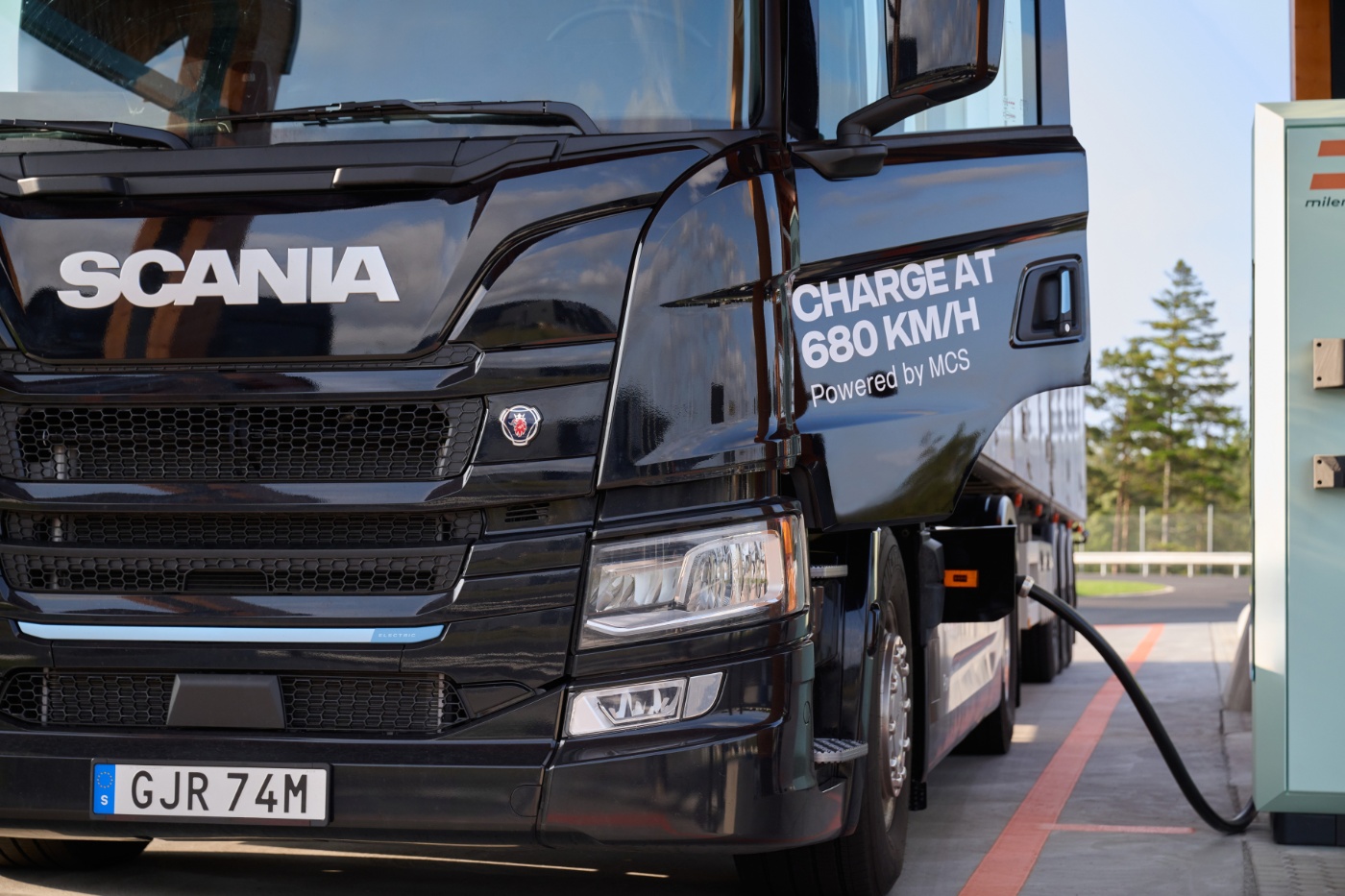
The technological foundation of the demonstration is the Megawatt Charging System, which is considered the new industry standard for the fast charging of heavy-duty commercial vehicles. MCS was developed specifically for electric trucks and buses and is intended to enable charging capacities of several megawatts in the future. In the long term, the standard provides for power outputs of up to 3.75 MW. This is expected to significantly shorten charging times and make battery-electric long-haul transport more economically viable.
Scania sees the new technology as particularly promising for depot charging. Vehicles are often parked there for extended periods, allowing bidirectional energy flows to be purposefully coordinated with the site's electricity demand and grid requirements. The combination of high-power charging and smart energy management could thus become an additional building block for the economic viability of electric commercial vehicle fleets.