.svg)
Highlights | September 17, 2026
This was Day 3
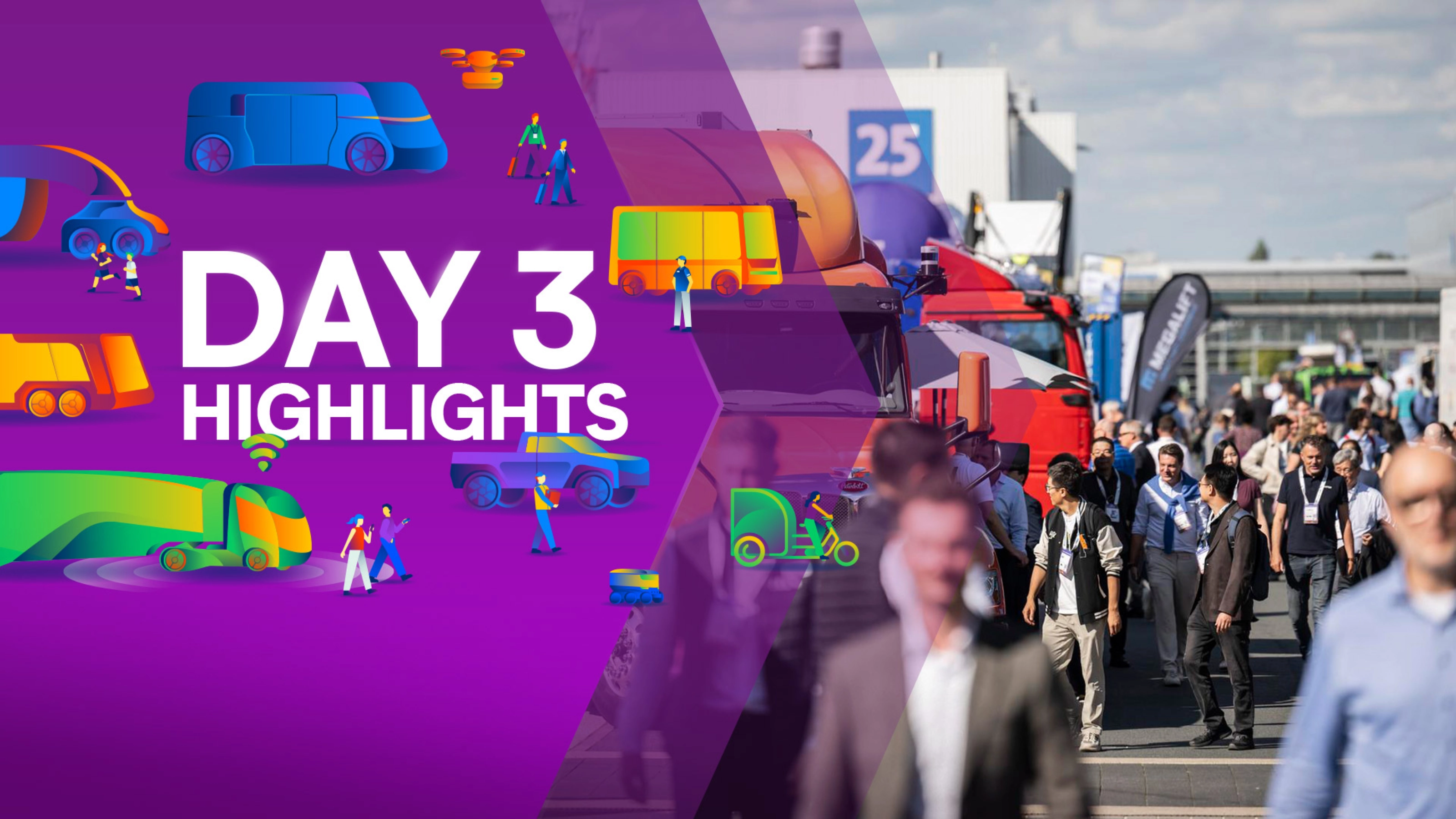
Day Three of IAA TRANSPORTATION 2026: Thursday Highlights
On Thursday, September 17, IAA TRANSPORTATION 2026 entered its third day. While the Main Stage at the IAA Conference has been closed since today, the Industry Stage focused on practical experiences with artificial intelligence, electric trucks, charging infrastructure, and new vehicle technologies. In addition, the prototype.club Stage hosted the Hackathon.
Visitors were also invited to experience commercial vehicles and their evolution firsthand through Test Drives, the Show Truck Mile, and the special exhibition celebrating the 50th anniversary of the International Truck of the Year. The megawatt charging demonstrations continued as well.
Day Three of IAA TRANSPORTATION 2026: Thursday Highlights
On Thursday, September 17, IAA TRANSPORTATION 2026 entered its third day. While the Main Stage at the IAA Conference has been closed since today, the Industry Stage focused on practical experiences with artificial intelligence, electric trucks, charging infrastructure, and new vehicle technologies. In addition, the prototype.club Stage hosted the Hackathon.
Visitors were also invited to experience commercial vehicles and their evolution firsthand through Test Drives, the Show Truck Mile, and the special exhibition celebrating the 50th anniversary of the International Truck of the Year. The megawatt charging demonstrations continued as well.
Artificial Intelligence in Practical Use
Starting Thursday, the Main Stage in Hall 18 was closed. The program on the Industry Stage in Hall 13 and on the prototype.club Stage in Hall 12 began with a McKinsey Morning Talk. Niklas Emlind, Head of Group Business Intelligence at Volvo Group, discussed current developments in the commercial vehicle industry with Anders Suneson from McKinsey & Company.
Next, TIMOCOM and freight forwarding company Hovanec demonstrated how artificial intelligence can assist dispatchers with freight assignment.
At noon, the Transport Forum hosted by HUSS-VERLAG focused on the concrete benefits of AI for the transport industry. Representatives from Volvo Group Trucks Technology, Geotab, Webfleet, and BPW discussed applications in dispatch, fleet management, and manufacturing. The primary focus was on which solutions already work in everyday operations, where limits exist, and what role the responsible handling of data plays.
Electric Trucks and Charging Infrastructure Reality Check
The panel on the E-Truck Tour Germany highlighted how well electric trucks are already functioning in daily logistics operations. Participants shared their experiences regarding driving behavior, energy consumption, and range, as well as charging and route planning. Load management, driving and rest times, and ongoing infrastructural challenges were also addressed.
Following this, Kempower presented insights from real-world electric truck operations in depots, logistics centers, and public charging stations. Real charging data demonstrated how far electrification has already progressed and the significance megawatt charging will gain in the coming years.
New Solutions for Trailers and Commercial Vehicles
ZF and trailer manufacturer KEMPF showcased how intelligent systems can enhance trailer safety. The Intelligent Electronic Braking System (iEBS) combines controlled braking, active safety, and connected features. In doing so, it sets the stage for automated driving, electrification, and software-defined commercial vehicles.
Another session was dedicated to vehicle-integrated photovoltaics. Representatives from Kässbohrer, IM Efficiency, OPES Solar Mobility, and Fraunhofer ISE showed how solar modules on trucks, buses, and vans can reduce fuel consumption and emissions. They discussed experiences from pilot projects and series production, technical challenges, regulatory frameworks, and economic viability in fleet operations.
PwC Strategy closed today's stage program by offering an international perspective on transformation, focusing on the global competition surrounding the electrification of truck transport.
Hackathon on the prototype.club Stage
The Hackathon took place on the prototype.club Stage in Hall 12, where participants worked on new solutions for the transport and logistics industry. Over the course of the day, teams developed solutions for software-defined commercial vehicles—specifically on how to securely integrate customer devices into light commercial vehicle platforms, ranging from cargo monitoring to fleet optimization. Partners including Bosch, Deloitte, and digital.auto mentored the teams throughout the day; in the evening, the best results were presented on stage and awarded prizes.
The accompanying stage program highlighted specific areas of innovation. For instance, the Ferdinand-Steinbeis-Institut presented a Bring-Your-Own-Device approach for software-defined commercial vehicles. This approach aims to enable the secure integration of external cameras, sensors, and smart devices, turning vehicles into flexibly expandable platforms.
Later, the focus shifted to a daily challenge faced by drivers: finding available truck parking spaces. Aeternum is developing a solution that forecasts capacity utilization at German highway rest stops up to eight hours in advance. In the future, this data will be made available to telematics providers, vehicle manufacturers, and fleets. Following that, another session addressed the path from prototype to market-ready product and how trust in new technologies is built.

Thank you! See you again in Hannover in 2028.
Thank you to everyone who was part of IAA TRANSPORTATION 2026.