.svg)
Highlights | September 15, 2026
A Look Back at Day 1
IAA TRANSPORTATION 2026 Kickoff: Highlights From Day One
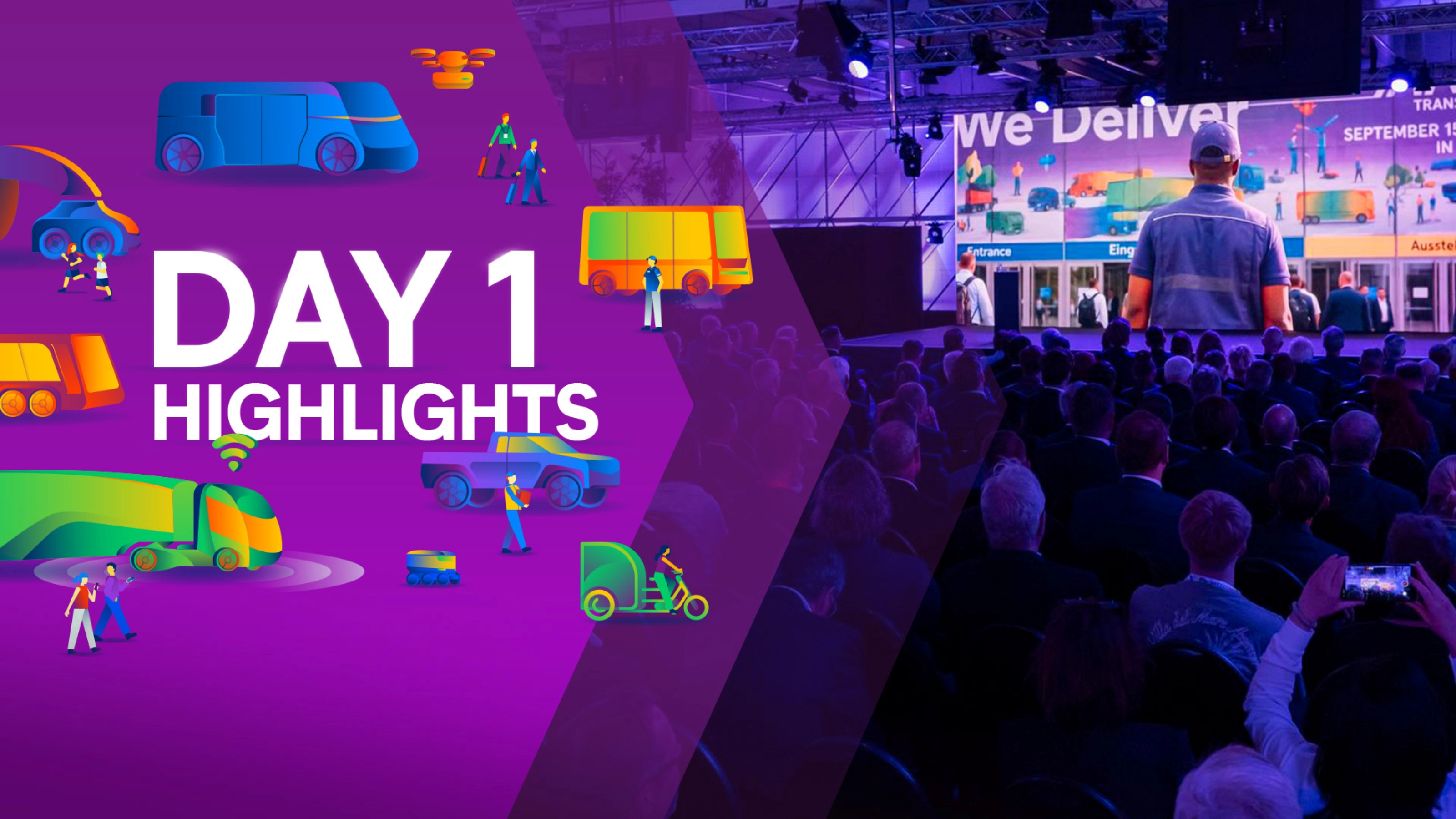
IAA TRANSPORTATION 2026 officially kicked off today, Tuesday, in Hanover. Right out of the gate, the opening day offered a dynamic lineup: top voices across industry, tech, logistics, and politics gathered on three stages to discuss the future of transport. The IAA Conference spotlighted a diverse series of keynotes throughout the day. Attendees also explored test drives, networking tours, the Showtruck Mile, megawatt charging demos, and the 16th IAA India Day.
IAA TRANSPORTATION 2026 Kickoff: Highlights From Day One
IAA TRANSPORTATION 2026 officially kicked off today, Tuesday, in Hanover. Right out of the gate, the opening day offered a dynamic lineup: top voices across industry, tech, logistics, and politics gathered on three stages to discuss the future of transport. The IAA Conference spotlighted a diverse series of keynotes throughout the day. Attendees also explored test drives, networking tours, the Showtruck Mile, megawatt charging demos, and the 16th IAA India Day.
Official Opening and High-Caliber Lineup on the Main Stage
IAA TRANSPORTATION 2026 was officially opened this morning by Federal Minister of Transport Steffen Bilger, Lower Saxony Prime Minister Olaf Lies, Mayor of Hanover Belit Onay, and VDA President Hildegard Müller.
VDA President Hildegard Müller emphasized: “The commercial vehicle industry stands for innovative technology, industrial value creation, and jobs, including around 140,000 jobs in Germany alone. At the same time, it has a key role to play in shaping the climate-neutral, digital mobility of the future. Heavy-duty transport accounts for nearly 30 percent of CO₂ emissions on Europe's roads. The potential is enormous. At IAA TRANSPORTATION this year, exhibitors are showing that our industry has delivered: The products for climate-neutral mobility are ready and operational. Through investment and innovation, we have developed the full range of technological options,” emphasized Hildegard Müller, President of the VDA.
“What is missing now are the right conditions to scale up as needed. Across Europe, charging and hydrogen refueling infrastructure, along with the supporting energy grids, is still lacking. The gap between ambition and reality is enormous. Yet this infrastructure is an essential prerequisite for actually getting our products on the road,” Müller said.
She added: “In many places, grid connections for depot charging take years, and our power grids are not adequately prepared for future requirements. This shows that Brussels is setting ambitious targets while neglecting the conditions needed to achieve them. Policymakers must deliver: We need a major acceleration in infrastructure rollout and a realistic assessment of the current situation in Germany and Europe. The EU review of CO₂ fleet regulations for commercial vehicles urgently needs to be brought forward and must allow for the necessary adjustments and greater flexibility. The industry is ready: It has developed innovative, climate-friendly solutions and is prepared to scale up further. What matters now is creating the necessary conditions, above all, high-performance charging infrastructure and the supporting power grids. The prospect of financial penalties, however, sends the wrong signal. They jeopardize growth, prosperity, and jobs. We also unequivocally reject penalties for problems for which we are not responsible. Our companies need predictability throughout the investment chain so that the transformation benefits the economy, the climate, and society.”
German Federal Minister for Digital and Transport Steffen Bilger: “IAA TRANSPORTATION is a showcase for technology and innovation, as well as for openness and inspiration. That is precisely what the commercial vehicle industry and the logistics sector stand for. A central priority is decarbonizing road freight transport. More than 120,000 electric commercial vehicles are already in daily operation for transport companies across Germany, including over 14,000 medium- and heavy-duty commercial vehicles. As the Federal Ministry for Digital and Transport, we are supporting this transition by ensuring that electric vehicles can be reliably charged in everyday operations. We are building out a fast-charging network along the autobahns for electric trucks and launching the concrete rollout phase at 124 unmanaged rest areas. However, we are not relying solely on a single powertrain technology. Through our funding, we will deploy at least 35 hydrogen refueling stations and support the procurement of around 500 commercial vehicles. This strengthens Germany's competitiveness as a logistics hub and accelerates the transition of road freight transport toward climate-friendly drive technologies.”
Lower Saxony Minister-President Olaf Lies emphasized: “The German commercial vehicle industry faces major challenges: International competition is intensifying, markets are changing, and the transition to climate-friendly powertrains requires substantial investment. The German commercial vehicle industry remains an important player and a key driver of innovation in climate-friendly mobility and modern logistics. This makes it even more important that we can rely on the innovative capabilities of our companies and their employees.”
“Lower Saxony is one of Europe's leading centers for commercial vehicles. IAA TRANSPORTATION provides an impressive demonstration of how future technologies are being developed here, with the potential to secure value creation, competitiveness, and good jobs for years to come. Today, more than ever, we need to consider industrial value creation, good jobs, and climate protection together. The IAA is a showroom for these efforts and an international showcase for Germany as a business location,” Lies added.
Attention then shifted to the core issues shaping the sector's future at the IAA Conference. Dan Priestley, Head of Semi at Tesla, kicked off the program in Hall 18, presenting the Tesla Semi and offering an outlook on how the automaker plans to bring its electric heavy-duty truck to Europe next year. Delivery of the first vehicles to European customers is scheduled to begin in 2027, as announced by the U.S. automaker at IAA TRANSPORTATION 2026. Matthias Kässer, Leader Commercial Vehicles at McKinsey & Company, then spoke on how the European truck industry can maintain its edge amid zero-emission drives, autonomous vehicles, artificial intelligence, and new international competitors.
Attention then shifted to the core issues shaping the sector's future at the IAA Conference. Dan Priestley, Head of Semi at Tesla, kicked off the program in Hall 18, presenting the Tesla Semi and offering an outlook on how the automaker plans to bring its electric heavy-duty truck to Europe next year. Delivery of the first vehicles to European customers is scheduled to begin in 2027, as announced by the U.S. automaker at IAA TRANSPORTATION 2026. Matthias Kässer, Leader Commercial Vehicles at McKinsey & Company, then spoke on how the European truck industry can maintain its edge amid zero-emission drives, autonomous vehicles, artificial intelligence, and new international competitors.

Next, representatives from BCG, MAN Truck & Bus, DHL Group, and TRATON Charging Solutions discussed strategies to accelerate the electric commercial vehicle transition in Europe. Discussions centered on expanding charging infrastructure, creating viable business models, and addressing fleet operator needs.
Einride, Lidl, and Schwarz Logistics Solutions demonstrated how autonomous transport logistics operates today in practice, using grocery retail delivery as a real-world case study. Additionally, Dr. Markus Heyn from Bosch and Jens Holtinger from Volvo Group provided insights into software-defined commercial vehicles, alternative drive systems, and the technological competitiveness of the European commercial vehicle sector.
Further insights came from Martin Fischer, CEO of FORVIA, and Markus Mildner, CEO of Siemens eMobility. Christoph Herr of Ford, Parliamentary State Secretary Christian Hirte, and ZF CEO Mathias Miedreich gathered to discuss innovation, competitiveness, and climate targets within commercial transport. Arnd Franz, CEO and Chairman of the Management Board at MAHLE, added further momentum to the program.
In the afternoon, heavy-duty electrification and autonomous driving took center stage again. Anja van Niersen, CEO of Milence, outlined the requirements for a pan-European charging network expansion. Antoine Duclaux, CEO of Renault Trucks, showcased how his company is integrating electric trucks into its own production workflows. Meanwhile, Volvo Autonomous Solutions, MAN Truck & Bus, and Kodiak AI debated why autonomous transport has moved far beyond a vision for the future into practical reality.
The Industry Stage in Hall 13 also featured a robust first-day schedule. The opening session provided an outlook on the 2026 European truck market and new sensor technologies designed to enhance safety around commercial vehicle perimeters. Deloitte followed with an analysis on how electrification and driver shortages are shifting total cost of ownership (TCO) for fleets.
The Industry Stage in Hall 13 also featured a robust first-day schedule. The opening session provided an outlook on the 2026 European truck market and new sensor technologies designed to enhance safety around commercial vehicle perimeters. Deloitte followed with an analysis on how electrification and driver shortages are shifting total cost of ownership (TCO) for fleets.
Afternoon sessions focused heavily on software-defined trucks, AI-driven vehicle diagnostics, and automated transport solutions. Representatives from Mercedes-Benz Trucks, Vodafone, digital.auto, and Deloitte discussed emerging digital value chains for commercial fleets. Bosch demonstrated how artificial intelligence enables predictive diagnostics to reduce downtime.
Additionally, experts from Volvo Autonomous Solutions, Plus, Bosch, and Kodiak AI mapped out the path for Level 4 technologies in real-world operations. The day concluded with a panel on green logistics featuring Porsche Consulting, Würth Industrie Service, DHL Group, and MAN Truck & Bus, which addressed scaling zero-emission freight transport from pilot projects to broad industrial application.
Innovations on the prototype.club Stage
New tech and emerging solutions took center stage on the prototype.club Stage in Hall 12. Topics ranged from AI-driven safety and telematics solutions to agent-based processes and innovative electric drive concepts.
Presentations highlighted electric powertrains, hydrogen technologies, smart electrical connectors, and axial flux motors for hybrid commercial vehicles. Korean tech companies also showcased their latest innovations. Meanwhile, the German Aerospace Center (DLR) and prototype.club presented a digital platform enabling test infrastructure to be shared and booked across Europe.
International Exchange at IAA India Day
The Convention Center hosted the 16th IAA India Day. The session focused on the impact of the EU-India Free Trade Agreement on trade, investment, and industrial cooperation. Representatives from politics, business, and industry discussed market developments, regulatory framework conditions, and emerging tech trends.
With these discussions, Day One of IAA TRANSPORTATION 2026 set a powerful benchmark—ranging from electrification and charging networks to software, AI, autonomous driving, international collaboration, and actionable real-world transport solutions.

Thank you! See you again in Hannover in 2028.
Thank you to everyone who was part of IAA TRANSPORTATION 2026.