
.svg)


Green Brenner Initiative: E-Trucks Aim to Make Transit Traffic More Climate-Friendly
Image: (c) MAN
With the newly founded "Green Brenner Initiative," MAN Truck & Bus, Dettendorfer Energy GmbH, and other partners from the logistics, energy, and infrastructure sectors want to drive the adoption of battery-electric trucks on one of Europe's most important transit routes. The goal is to establish the Brenner corridor as a model region for zero-emission logistics, helping to relieve the climate, environment, and local residents even before the completion of the Brenner Base Tunnel.
With the newly founded "Green Brenner Initiative," MAN Truck & Bus, Dettendorfer Energy GmbH, and other partners from the logistics, energy, and infrastructure sectors want to drive the adoption of battery-electric trucks on one of Europe's most important transit routes. The goal is to establish the Brenner corridor as a model region for zero-emission logistics, helping to relieve the climate, environment, and local residents even before the completion of the Brenner Base Tunnel.
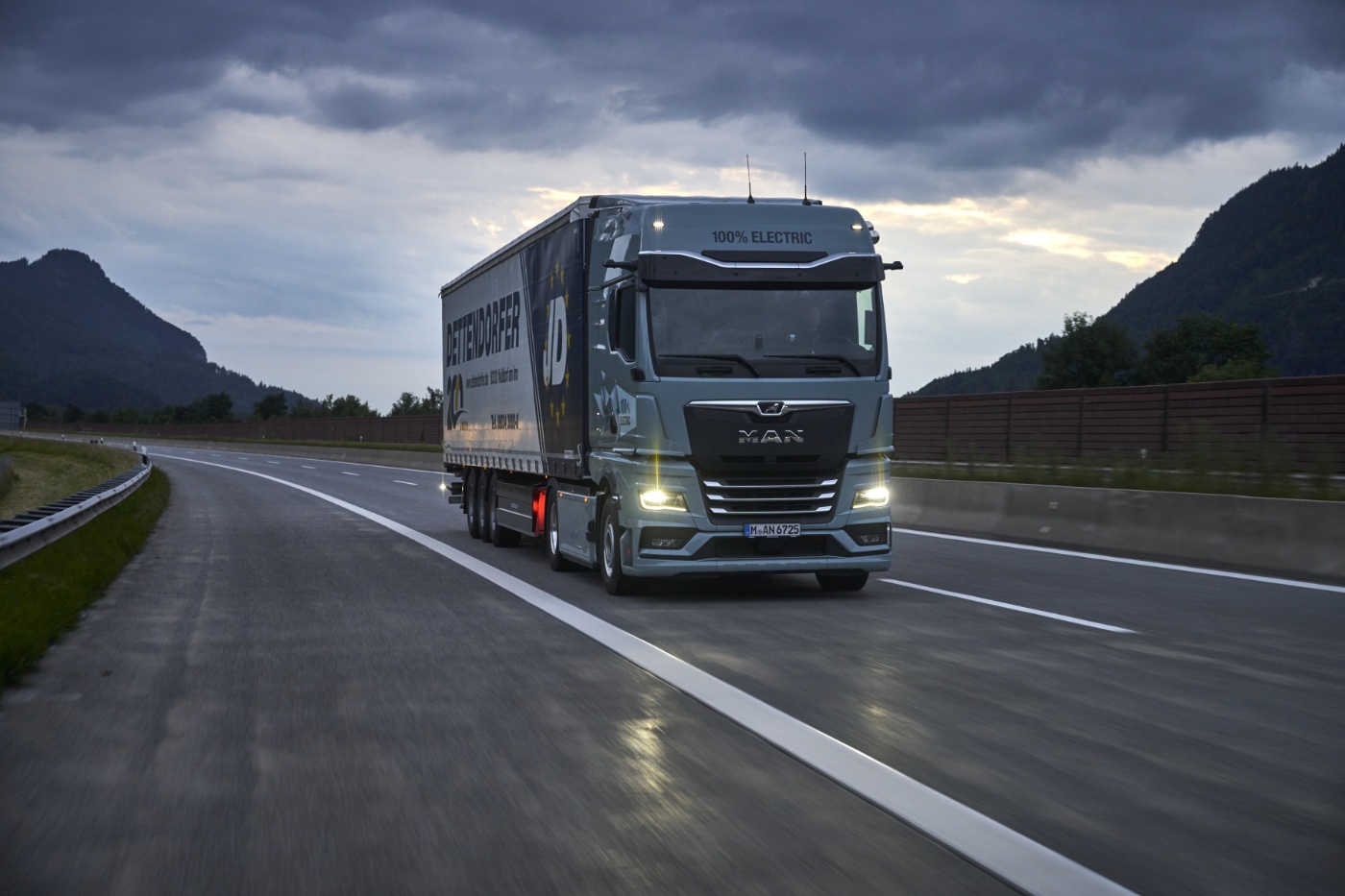
At the heart of the initiative is the significant potential for reducing CO₂ emissions. According to the initiative, a battery-electric truck with an annual mileage of around 110,000 kilometers (approx. 68,000 miles) can save an average of 95 tons of CO₂ per year compared to a comparable diesel truck. Deploying just 300 e-trucks daily on the Brenner route would enable an annual reduction of up to 28,000 tons of CO₂—a figure equivalent to the emissions of a small town.
In addition to the climate benefits, the initiators also promise noticeable improvements for residents living along the transit route. During acceleration, electric trucks produce around 12.6 decibels less noise than diesel-powered vehicles and are subjectively perceived as about half as loud. Especially in the narrow valleys along the Brenner route, this could tangibly reduce the burden of freight traffic. Furthermore, battery-electric vehicles operate with virtually zero local emissions. Particulate emissions from internal combustion engines are completely eliminated, while energy recovery through regenerative braking additionally reduces brake wear.
The initiative also sees economic advantages for the transport industry. According to the project partners, the energy costs of an e-truck are currently around 40 percent lower than those of a diesel truck. On the demanding Brenner route, regenerative braking also shows its strengths: when driving downhill, the vehicles can recover up to 40 percent of the energy previously used. Further savings come from toll costs, which are currently around 80 percent lower for electric trucks. Overall, the total cost of ownership (TCO) over a three-year period is expected to be about 20 percent lower than that of comparable diesel vehicles.
The initiative explicitly views itself as a complement to rail transport, not as competition. Until the completion of the Brenner Base Tunnel, e-trucks are intended to offer a short-term, readily available solution for more climate-friendly transport. Even after its completion, the initiators see applications for traffic that cannot be shifted to rail. However, a widespread scaling of the project remains dependent on the continued expansion of charging infrastructure and grid capacities along the European transit corridor.
With the Green Brenner Initiative, the participating companies want to demonstrate that heavy-duty battery-electric transport can be operated economically and practically, even under challenging topographical conditions. At the same time, the project is intended to serve as a blueprint for other European transport corridors and accelerate the transformation of road freight transport.